

Demographics are the most reliable of all the forces that shape long-term real estate demand. Unlike economic cycles, which are inherently difficult to predict in their timing and magnitude, or market sentiment, which can shift rapidly in response to news events, demographic trends are visible years or even decades in advance. The population is growing or declining. The age structure of the population is shifting. Migration patterns are changing. Household sizes are evolving. Each of these changes translates into real estate demand shifts for different sizes, configurations, locations, and types of property, with a predictability that should inform long-term investment strategy far more systematically than it typically does.
In the Indian Ocean region, and in Mauritius specifically, where the Apavou Group has been observing and responding to market dynamics for more than four decades under the leadership of founder Armand Apavou, demographic trends are creating significant and sustained shifts in real estate demand that are already visible in the market and that will intensify over the coming decades. Understanding these trends, and what they mean for the long-term demand outlook for different categories of Mauritius real estate including assets like Plaisance Mall, Terre d’Été, and The Cube, is one of the most important analytical disciplines for serious long-term investors in the market.
The Mauritius demographic profile, key trends
Mauritius has a population of approximately 1.3 million people, which has been relatively stable in recent years following a sustained decline in fertility rates that has brought the island’s birth rate below the replacement level. This demographic transition, from a younger, growing population to an older, more stable one, is one of the most important structural changes affecting long-term real estate demand on the island. A population with a declining proportion of young adults forms fewer new households, demands less new residential space, and has different preferences in terms of housing size, location, and configuration than a younger, growing population.
The ageing of the Mauritius population creates specific demand shifts across real estate categories. Demand for larger family homes in suburban or peri-urban locations, the traditional demand of young families, will gradually moderate as the young family demographic shrinks as a proportion of the population. Demand for smaller, more manageable residential properties, apartments and maisonettes suited to empty-nester and elderly households, will grow. Demand for age-related services and facilities, healthcare, assisted living, and community services, will increase substantially as the proportion of the population above retirement age grows.
The international buyer, a demographic dividend for Mauritius
Against the backdrop of a stable or modestly declining local population, Mauritius has benefited enormously from the demographic dynamics of its international buyer market, particularly the large and growing cohort of European and South African high-net-worth individuals who have discovered the island as a lifestyle investment and residency destination over the past two decades. This internationally mobile demographic, typically successful professionals and business owners in their forties and fifties, seeking a combination of lifestyle quality, tax efficiency, and investment diversification, has been a powerful driver of demand for the premium IRS and PDS residential market that represents the most internationally visible segment of Mauritius real estate.
The continued growth of this international buyer demographic, driven by increasing global wealth, expanding awareness of Mauritius as an investment destination, and the growing ease of international mobility, provides a structural demand underpinning for the premium Mauritius residential market that is relatively independent of the island’s own population dynamics. For developments like Terre d’Été in the Apavou Group’s portfolio, which are positioned for this international buyer demographic, the demographic tailwind from internationally mobile wealth is one of the most important long-term demand drivers.
The indian buyer demographic, an emerging force
Among the most significant recent demographic shifts in the Mauritius international buyer market has been the emergence of Indian high-net-worth buyers as a growing and increasingly important segment of demand for premium Mauritius real estate. India’s rapidly expanding wealthy class, now one of the largest and fastest-growing globally, is increasingly looking at Mauritius as a preferred destination for lifestyle investment and residency, attracted by the island’s Indian cultural connections, its strong bilateral relationship with India, its geographical proximity by regional standards, and its well-established legal and investment framework. This Indian buyer demographic represents a structural addition to the Mauritius premium market demand base that will likely become more significant as Indian wealth continues to grow and as awareness of Mauritius as an investment destination increases within this demographic.
The remote work revolution and its impact on Mauritius real estate
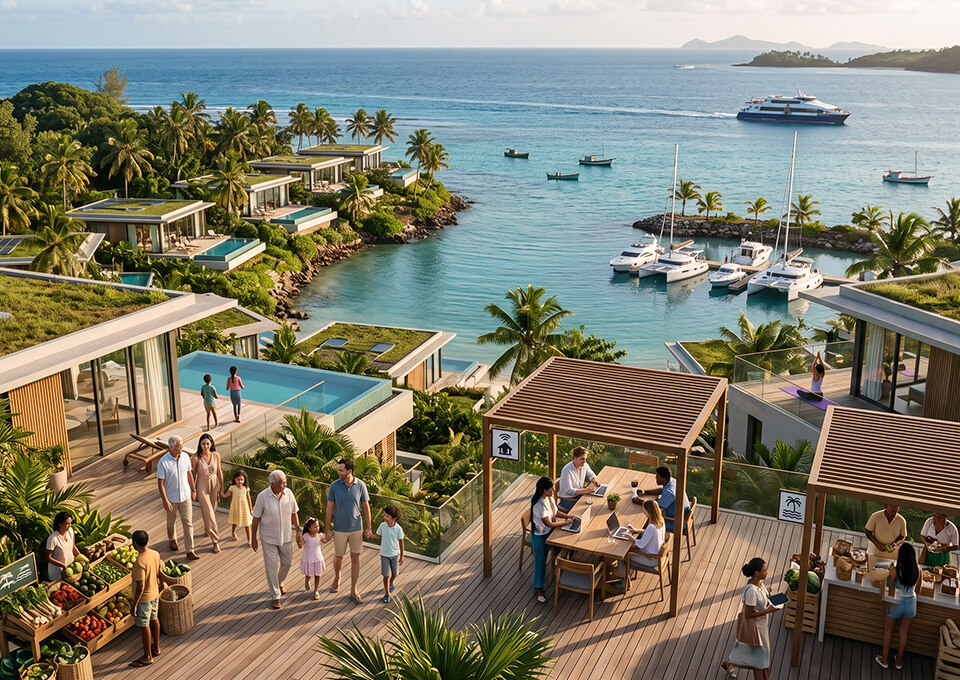
One of the most significant demographic shifts with implications for the Mauritius real estate market is the post-Covid transformation in work patterns, specifically the sustained adoption of remote and hybrid working among a large segment of the global knowledge economy workforce. This transformation has fundamentally changed the locational constraints that previously bound professional workers to the cities where their employers were based, enabling a genuinely new category of property demand: the long-term remote working resident who chooses to base themselves in a lifestyle destination like Mauritius for extended periods while continuing to earn income from international professional activity.
Mauritius has actively sought to attract this demographic through the Premium Visa programme and related residency pathways, recognising that high-earning remote workers represent a particularly attractive form of economic migrant, one who brings income earned abroad into the local economy without displacing local employment, who demands and can afford quality housing and lifestyle amenities, and who contributes to the cultural and social dynamism of the community. The real estate implications of this remote-worker demographic are significant: demand for quality, well-connected residential accommodation suitable for a permanent or semi-permanent lifestyle rather than a vacation property, with good telecommunications infrastructure, adequate workspace, and access to international schools and healthcare for family members.
Generational preferences and their real estate implications
The generational composition of both the Mauritius local population and the international buyer market is shifting in ways that have important implications for the types, locations, and characteristics of real estate that will be in the strongest demand over the next decade and beyond. The Millennial generation, born roughly between 1981 and 1996, is now entering the prime wealth accumulation and property purchasing phase of life globally. This generation has meaningfully different real estate preferences from the Baby Boomer and Generation X demographics that have dominated the luxury and international buyer market for the past two decades.
Millennials broadly prefer urban or well-connected locations over isolated resort settings, sustainability credentials over conventional luxury amenities, flexible space that adapts to multiple uses over single-purpose rooms, and community and wellness orientation over purely aesthetic prestige. For the Mauritius real estate market, including the commercial environment served by assets like The Cube and Plaisance Mall, these generational preference shifts are gradually changing what quality means, which locations are most desirable, and what amenity offerings are most valued.
African wealth and the Indian Ocean Real Estate opportunity
One of the most significant demographic trends with long-term implications for Indian Ocean real estate is the growth of African high-net-worth wealth, particularly from sub-Saharan Africa, where economic growth, natural resource wealth, and expanding business activity are creating a new generation of wealthy individuals who are actively seeking international investment and residency options. Mauritius, as the most sophisticated and best-governed financial and lifestyle investment destination in the African region, is naturally positioned to attract a growing share of this African wealth as it seeks international diversification.
The African high-net-worth demographic represents a potentially very large and sustained source of demand for Mauritius premium real estate over the coming decades, one that is geographically proximate, culturally compatible, and increasingly aware of Mauritius as a destination. For developers and investors in the Mauritius premium market, the development of marketing and distribution strategies that reach this African wealth demographic, through African financial advisers, through African business networks, and through direct engagement with the growing African HNW community, is an important strategic investment in access to the demographic tailwind that this market represents.
Demographic intelligence as an investment strategy
For long-term real estate investors in Mauritius, incorporating systematic demographic analysis into investment strategy is not optional; it is essential to identifying where genuine long-term demand growth is heading and positioning portfolios to capture that growth. This means monitoring the key demographic trends affecting both the local and international demand bases for Mauritius real estate, translating those trends into specific implications for different real estate categories and locations, and using those implications to inform development pipeline direction, acquisition targeting, and disposal timing.
The Apavou Group’s approach to long-term market analysis, developed over four decades of sustained Mauritius market engagement, incorporates demographic trend analysis as a foundational input to strategic portfolio direction. The group’s investment decisions across Plaisance Mall, Terre d’Été, The Cube, and the broader Mauritius portfolio reflect an understanding of the demographic forces shaping the market’s long-term demand trajectory, and the ambition to position each asset to serve the most important and most sustainable of those demand flows.
Demographics as the most reliable long-term signal
In the Mauritius real estate market, demographic trends provide among the most reliable and most actionable long-term investment signals available. Population ageing, international buyer demographic expansion, the remote work revolution, generational preference shifts, and the growth of African wealth are all visible, measurable, and already influencing market demand in ways that will intensify over the coming decade. Investors and developers who incorporate these demographic insights systematically into their strategic thinking, who position their portfolios to benefit from the most powerful of these demographic forces, will consistently make better long-term investment decisions than those who focus primarily on current market conditions and short-term cycles. At Apavou Insights, demographic analysis is one of the most important inputs to the long-term perspective that defines our approach to the Mauritius real estate market.
 Previous Post
 Next Post